Geometry Inputs and Pipelines
NEO operates in Boozer coordinates, where the magnetic field can be written in contravariant and covariant forms,
This representation is the basis for the Boozer transform and the boozmn
file format consumed by NEO_JAX. [2, 4]
Required data for NEO
NEO expects Fourier coefficients on each flux surface:
rmnc: cosine coefficients of cylindrical radius.zmns: sine coefficients of vertical coordinate.lmns: sine coefficients of the Boozer toroidal angle shift.bmnc: cosine coefficients of magnetic field magnitude.ixm,ixn: poloidal and toroidal mode numbers.iota: rotational transform profile.curr_polandcurr_tor: Boozer currents \(I\) and \(G\).nfp: number of field periods.
Mapping from boozmn
The standard boozmn netCDF file (from BOOZ_XFORM) provides arrays such as
rmnc_b, zmns_b, bmnc_b, pmns_b, ixm_b, ixn_b, iota_b,
bvco_b, and buco_b. NEO maps these to its internal representation using
The Boozer currents are mapped as curr_pol = bvco_b and
curr_tor = buco_b. The file reader also computes the normalized toroidal
flux coordinate
which is the radial coordinate surfaced in the public API.
The main file-based reader is:
def read_boozmn(
    path: str | Path,
    *,
    max_m_mode: int = 0,
    max_n_mode: int = 0,
    fluxs_arr: Optional[Sequence[int]] = None,
    extension: str | None = None,
) -> BoozerData:
    """Read a boozmn netCDF file and return BoozerData.

    This function follows the packing conventions used in STELLOPT's
    read_boozer_mod, but only retains the surfaces requested.
    """
    _require_netcdf4()
    booz_path = resolve_boozmn_path(path, extension)

    with netCDF4.Dataset(booz_path) as ds:  # type: ignore[union-attr]
        nfp = int(ds.variables["nfp_b"][:])
        ns_b = int(ds.variables["ns_b"][:])
        mboz_b = int(ds.variables["mboz_b"][:])
        nboz_b = int(ds.variables["nboz_b"][:])

        ixm_b = np.array(ds.variables["ixm_b"][:], dtype=int)
        ixn_b = np.array(ds.variables["ixn_b"][:], dtype=int)

        iota_b = np.array(ds.variables["iota_b"][:], dtype=float)
        buco_b = np.array(ds.variables["buco_b"][:], dtype=float)
        bvco_b = np.array(ds.variables["bvco_b"][:], dtype=float)
        pres_b = np.array(ds.variables["pres_b"][:], dtype=float) if "pres_b" in ds.variables else None

        rmnc_raw = np.array(ds.variables["rmnc_b"][:], dtype=float)
        zmns_raw = np.array(ds.variables["zmns_b"][:], dtype=float)
        pmns_raw = np.array(ds.variables["pmns_b"][:], dtype=float)
        bmnc_raw = np.array(ds.variables["bmnc_b"][:], dtype=float)
        gmn_raw = np.array(ds.variables["gmn_b"][:], dtype=float) if "gmn_b" in ds.variables else None

        if "jlist" in ds.variables:
            jlist = np.array(ds.variables["jlist"][:], dtype=int)
        else:
            jlist = np.arange(1, rmnc_raw.shape[0] + 1, dtype=int)

    pack_len = rmnc_raw.shape[0]
    rmnc_pack = _transpose_if_needed(rmnc_raw, pack_len)
    zmns_pack = _transpose_if_needed(zmns_raw, pack_len)
    pmns_pack = _transpose_if_needed(pmns_raw, pack_len)
    bmnc_pack = _transpose_if_needed(bmnc_raw, pack_len)
    gmn_pack = _transpose_if_needed(gmn_raw, pack_len) if gmn_raw is not None else None

    max_m = max_m_mode if max_m_mode > 0 else mboz_b - 1
    max_n = max_n_mode if max_n_mode > 0 else nboz_b * nfp
    mode_mask = _select_modes(ixm_b, ixn_b, max_m, max_n)

    ixm = ixm_b[mode_mask]
    ixn = ixn_b[mode_mask]
    mode0 = np.where((ixm_b == 0) & (ixn_b == 0))[0]
    mode0_idx = int(mode0[0]) if len(mode0) else None

    pack_index = {int(surf): idx for idx, surf in enumerate(jlist)}

    if fluxs_arr is not None:
        surfaces = list(fluxs_arr)
    else:
        surfaces = list(jlist)

    rmnc = []
    zmns = []
    lmns = []
    bmnc = []
    es = []
    iota = []
    curr_pol = []
    curr_tor = []
    pprime = []
    sqrtg00 = []

    hs = 1.0 / (ns_b - 1)
    for surf in surfaces:
        pack_idx = pack_index.get(int(surf))
        if pack_idx is None:
            raise ValueError(f"Surface {surf} not found in boozmn jlist")

        rmnc.append(rmnc_pack[pack_idx, mode_mask])
        zmns.append(zmns_pack[pack_idx, mode_mask])
        lmns.append(-pmns_pack[pack_idx, mode_mask] * nfp / (2.0 * math.pi))
        bmnc.append(bmnc_pack[pack_idx, mode_mask])

        es.append((surf - 1.5) * hs)
        iota.append(iota_b[surf - 1])
        curr_pol.append(bvco_b[surf - 1])
        curr_tor.append(buco_b[surf - 1])
        if pres_b is not None and surf < ns_b:
            pprime.append((pres_b[surf] - pres_b[surf - 1]) / hs)
        else:
            pprime.append(0.0)
        if gmn_pack is not None and mode0_idx is not None:
            sqrtg00.append(float(gmn_pack[pack_idx, mode0_idx]))
        else:
            sqrtg00.append(0.0)

    return BoozerData(
        rmnc=np.asarray(rmnc),
        zmns=np.asarray(zmns),
        lmns=np.asarray(lmns),
        bmnc=np.asarray(bmnc),
        ixm=np.asarray(ixm),
        ixn=np.asarray(ixn),
        es=np.asarray(es),
        iota=np.asarray(iota),
        curr_pol=np.asarray(curr_pol),
        curr_tor=np.asarray(curr_tor),
        nfp=nfp,
        pprime=np.asarray(pprime),
        sqrtg00=np.asarray(sqrtg00),
    )
End-to-end JAX pipeline
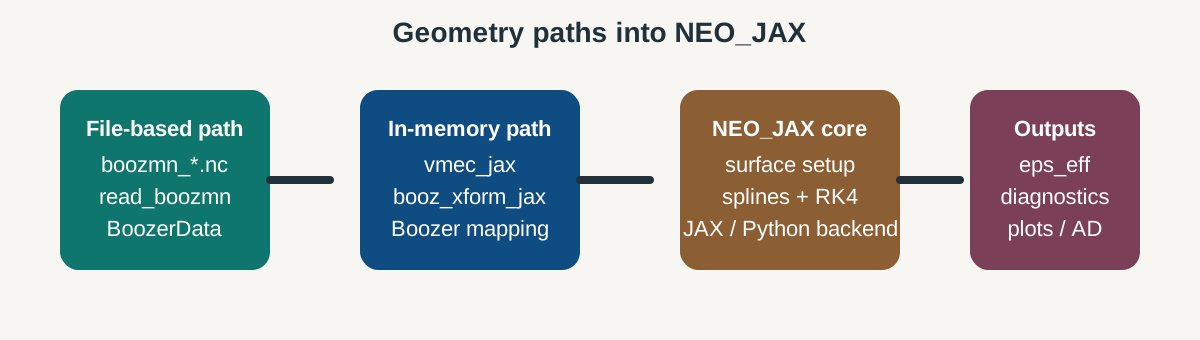
NEO_JAX is designed to consume the outputs of vmec_jax and
booz_xform_jax directly, avoiding intermediate files and enabling
end-to-end differentiation. [3, 4]
When using this pipeline, ensure the following:
The Boozer transform uses the same field-period convention as NEO.
Mode truncation matches
max_m_modeandmax_n_modefrom the control file.The current profiles supplied to NEO are consistent with the Boozer convention.
NEO_JAX provides neo_jax.io.booz_xform_to_boozerdata() to convert arrays
from a booz_xform-style object into the BoozerData container used by the
solver, and neo_jax.run_neo() (or neo_jax.run_booz_xform()) to run
the solver directly on that object with a high-level configuration.
When the Boozer transform returns JAX arrays (from booz_xform_jax.jax_api),
use neo_jax.io.booz_xform_to_boozerdata_jax() to preserve device arrays
and keep the pipeline differentiable.
For pipeline workflows, see neo_jax.run_boozer_to_neo() and
neo_jax.run_vmec_boozer_neo() for convenience wrappers.
For a JAX-native VMEC state → Boozer adapter plus a JAX surface scan, use
neo_jax.run_vmec_boozer_neo_jax(). This path avoids NumPy in the VMEC→Boozer
interface and is suitable for autodiff experiments.
For repeated solves (e.g., optimization loops), build a reusable pipeline:
from neo_jax import NeoConfig, build_vmec_boozer_neo_jax

solver = build_vmec_boozer_neo_jax(
    run,
    booz_kwargs=dict(mboz=8, nboz=8),
    neo_config=NeoConfig(surfaces=[0.5]),
    jit=True,
)
outputs = solver(run.state)
Example: vmec_jax → booz_xform_jax → neo_jax
from neo_jax import NeoConfig, run_vmec_boozer_neo

config = NeoConfig(surfaces=[0.25, 0.5, 0.75], theta_n=32, phi_n=32)
results = run_vmec_boozer_neo(
    "path/to/input.vmec",
    vmec_kwargs=dict(max_iter=1, use_initial_guess=True, vmec_project=False),
    booz_kwargs=dict(mboz=8, nboz=8),
    neo_config=config,
)
Operational notes:
For accurate surface mapping, it is recommended to let the Boozer step compute all VMEC half-grid surfaces and use the NEO surface selection (
NeoConfig.surfaces) to pick the subset.The in-memory path avoids file I/O entirely.
The JAX-native path is the preferred route for repeated solves and differentiation experiments.